
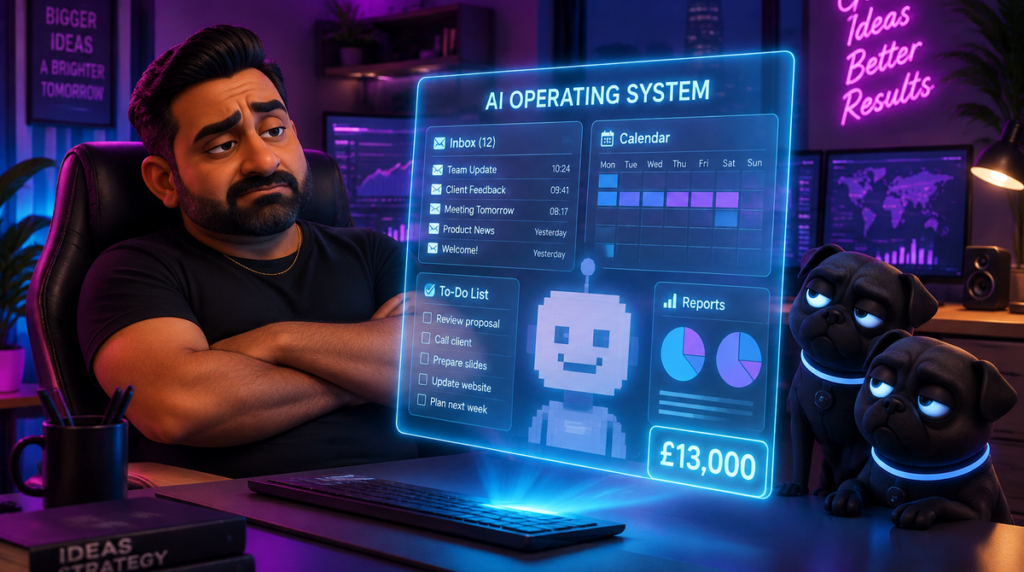
I’ve just come back from seeing another business owner who has been sold the dream of AI.
And before anyone gets the wrong idea, I’m not anti-AI. Far from it. We use AI ourselves. We build automations around it. I use it for development, research, workflow automation, data processing, content and plenty of other things. Used properly, AI is an incredibly useful tool.
But there is a massive difference between using AI to solve an actual business problem and selling somebody a £10,000 or £15,000 box of tricks because you’ve frightened them into believing their business will become obsolete without it.
And right now, that fear is particularly easy to sell.
Businesses are already under pressure
A lot of UK businesses are having a difficult time at the moment, particularly SMEs. Costs have increased. Wages have increased. Employment costs have increased. Energy, insurance, finance, suppliers and pretty much everything else are taking another bite.
Customers are being more careful with their money, businesses are being more cautious about spending and margins are being squeezed from both directions. There isn’t one thing you can point at and say, “That’s why business is down.” It’s a combination of factors.
And when you run a small or medium-sized business, you feel those changes quickly. If enquiries drop 20%, you notice. If advertising costs increase while conversions fall, you notice. If customers suddenly take three weeks to make a decision that previously took three days, you notice.
Eventually, you start asking the obvious question:
What am I doing wrong?
Sometimes the answer is: nothing. The market around you has changed.
That doesn’t mean you shouldn’t adapt. Of course you should. But you need to understand what you’re adapting to before somebody turns up with the solution conveniently tucked under their arm.
And this is where AI enters the equation.
AI has created a huge amount of noise
One thing AI has done exceptionally well is make things easier and cheaper to produce.
Writing used to take time. Design took time. Building a website took time. Producing videos took time. Writing 100 personalised prospecting emails took a ridiculous amount of time.
Now you can generate articles, adverts, emails, sales messages, images, videos, proposals and social posts at a scale that would have required an entire team a few years ago. Then you can automate the distribution of all of it.
Brilliant.
Except everyone else can do exactly the same thing. We haven’t created more human attention. We’ve simply created considerably more things fighting for it.
Your customer still only has 24 hours in a day. Their inbox is full. LinkedIn is full. Facebook is full. Their phone is going off every five minutes. They’ve got WhatsApp, Teams, email, YouTube, TikTok, podcasts, newsletters, adverts and approximately seven million people wanting to “jump on a quick 15-minute call”.
Then we’re surprised when another automated marketing email doesn’t get a response.
Ask yourself what you do. I know what I do. I delete most of it. Not necessarily because the companies contacting me are rubbish. Some of them might actually offer something useful. I simply haven’t got the time or inclination to investigate every single one.
That’s the problem. Being useful isn’t necessarily enough to get noticed any more. You have to earn somebody’s attention first.
Then there’s AI slop
We’ve also created what people increasingly call AI slop. Content produced simply because somebody can produce it.
Three LinkedIn posts a day because somebody decided that’s what the algorithm wants. Fifty SEO articles a month. Hundreds of automated emails. Generic sales messages. AI comments underneath AI posts responding to somebody else’s AI-generated article.
It’s getting ridiculous. And people are getting very good at spotting it.
You know the emails:
“I was looking at your website and noticed…”
No you weren’t. Something scraped my website. Something else generated an email from it and another automation sent it. Let’s not pretend somebody spent Sunday evening admiring my About Us page.
The bigger problem is that genuine communication gets caught in the same filter. A real business with something genuinely useful to say can be ignored because its message looks exactly like the other 150 automated messages sitting in somebody’s inbox.
AI has made marketing incredibly cheap to produce. It has arguably made attention more expensive to obtain.
That distinction matters, because producing more marketing doesn’t mean customers suddenly want to consume more of it. Quite the opposite. People are filtering harder, deleting faster, scrolling faster and increasingly sticking with companies and people they already know and trust.
Producing more isn’t necessarily the answer. Sometimes producing more is part of the problem.
The old marketing methods aren’t dead
Email isn’t dead. SEO isn’t dead. Social media isn’t dead. Content marketing isn’t dead.
But businesses need to be realistic about what these things actually achieve. Posting regularly can keep you visible. A newsletter can keep you connected with existing customers. Social media can show people that you’re active. Good technical articles can demonstrate knowledge and give search engines and AI systems useful information about your company.
All worthwhile.
But don’t assume that five generic AI-generated LinkedIn posts every day will suddenly become your company’s major growth engine. They probably won’t. The easy stuff has become easy for everybody, and once everybody can do something, simply doing it stops being a competitive advantage.
Search has changed as well. Someone searches for something today and they might get an AI answer, maps, videos, products, adverts, snippets and FAQs before they ever reach a traditional organic result. So you can rank well and still not get the click.
That doesn’t make SEO pointless. It means the customer journey has changed. Your website matters. Your expertise matters. Your reputation matters. But simply existing on page one is no longer the whole game.
Now look at this from the business owner’s position
Your enquiries are down, your marketing isn’t producing what it once did, advertising is getting more expensive and customers seem harder to reach. And everywhere you look, somebody is telling you AI is changing the world.
Then an AI agency comes along.
“We know what your problem is.”
You need AI. They’ll streamline the company. Generate more leads. Increase productivity. Automate everything. Future-proof the business. And apparently everybody now needs an AI “operating system”.
If you don’t implement one, you’ll be left behind. Competitors will overtake you. Your business will suffer.
That is an incredibly powerful sales pitch when you’re already worried about where next month’s orders are coming from.
Which brings me to the business I recently visited.
He’d spent around £13,000
This particular business owner had seen his marketing slow down. Leads were falling and the return from his existing marketing wasn’t particularly good.
Naturally, he started questioning what was happening. Had he done something wrong? Had the market changed? Was he falling behind?
Then an AI agency approached him. They explained that they could streamline his operation, introduce automation and help generate more leads. They also told him he needed their AI operating system. Apparently, this was becoming essential.
Eventually, he agreed. By the time everything had been installed, configured and paid for, he’d spent somewhere around £13,000.
For the first couple of weeks it all looked quite impressive.
Then they started actually using it.
Automations weren’t running properly. Information generated by the system was wrong. Some of it was completely fabricated. The model was inventing details that had never existed anywhere in the business.
Parts of it had been connected to financial processes. That’s where it stopped being an inconvenience. Once a system that invents things is touching finance data, somebody has to check every single output before it goes anywhere. Customer details were wrong. Part numbers were wrong. Processes failed.
And one of the biggest problems with AI became very obvious. It can give you a completely incorrect answer with exactly the same confidence as a correct one.
So the staff now had another job.
Checking the AI.
Think about that. You’ve spent thousands automating a process and then created another manual process to check that the automation hasn’t cocked it up.
That isn’t particularly intelligent automation.
That’s babysitting software.
Then I saw the “AI operating system”
This was the bit that really got me.
I eventually sat down in front of this AI operating system. It was basically a dashboard.
Emails. Calendar. To-do list. Some company information. A few widgets. And naturally, the obligatory AI voice assistant.
Very futuristic. Very Jarvis.
Unfortunately, Jarvis looked and sounded like he’d been ordered from Temu.
The voice system wasn’t particularly good. The interface wasn’t particularly good. It was slow. And parts of the AI processing were being pushed onto local computers that simply didn’t have the hardware for it.
There’s absolutely nothing wrong with local AI. We use local systems ourselves, and there are very good reasons for doing it: privacy, security, control, availability and, in certain circumstances, cost. But you still need the right hardware. You need the right architecture. And most importantly, you need an actual reason for doing it.
This business didn’t need Jarvis. It needed several fairly straightforward business problems fixing.
Start with the problem, not the technology
This is where I think a lot of AI projects go wrong. The first question shouldn’t be:
Where can we put AI?
It should be:
What are we actually trying to fix?
If somebody spends ten hours every week doing repetitive administration and automation can reduce that to two hours, fantastic. There’s a business case. If quotations take 45 minutes to prepare and a properly controlled system can reduce that to ten minutes, brilliant. Measure the saving. If a customer service team answers the same questions over and over, technology might help there as well.
AI can analyse incoming enquiries, identify what they’re about, extract important information and route them to the correct person. Useful.
It can summarise a 30-message email chain. Useful.
It can extract structured information from documents. Useful.
It can help prepare the first draft of a quotation based on approved product information. Useful.
It can identify anomalies across thousands of records that somebody would struggle to review manually. Very useful.
In every one of those examples, we’ve started with a problem. That’s the difference.
Putting everything into a shiny dashboard because it looks good during a demonstration isn’t digital transformation.
It’s a dashboard.
And sometimes a business doesn’t need AI at all. It needs to sort its processes out. I appreciate that doesn’t sound quite as exciting. Nobody posts on LinkedIn:
“Fantastic news. After months of hard work, we’ve finally organised our filing system.”
But sometimes that’s what needs fixing. If your sales process is poor, fix it. If your website isn’t converting, fix it. If nobody follows up enquiries, fix that. If your customer database is a mess, or five employees enter the same information differently into five different systems, deal with that first.
Then automate.
Because automating a rubbish process doesn’t magically make it good. It just makes the rubbish move faster.
AI won’t magically fix your marketing either
This was particularly relevant to the business I visited. The original concern was leads. But nobody had properly answered the most important question:
Why had the leads dropped?
That’s what needed investigating. Has demand fallen? Has the market changed? Are customers spending less? Have competitors moved? Has paid advertising become more expensive?
Or is it closer to home. Has organic traffic fallen? Has the website stopped converting? Are customers getting their answers directly from search engines without ever visiting the website? Has the company’s message become stale, and is its marketing disappearing into the same sea of generic content as everybody else’s?
You diagnose the problem first. AI might help with that diagnosis. AI might then form part of the solution. But AI isn’t automatically the solution.
There isn’t a button marked “Generate 30% More Customers”.
If anyone does find it, send me the link.
Maybe businesses need to become more human
This is where I think things get interesting.
If anybody can generate an article, email, image or LinkedIn post in 30 seconds, those things inevitably become less distinctive.
So what becomes valuable? The things that aren’t as easy to reproduce. Your experience, your reputation, your customer relationships, your technical knowledge, your case studies, your people, your history, your facilities. Real photographs. Real opinions based on actually doing the work. Original research. Detailed technical information created by somebody who genuinely understands the subject.
Those things are harder. That’s precisely why they have value.
We’ve spent years trying to remove every bit of friction from marketing. Automate this. Schedule that. Generate this. Scale that. Send 10,000 instead of 100. Operationally, I understand it.
But if something takes absolutely no effort for you to send, there’s a good chance the person receiving it knows that as well.
Compare an automated email sent to 20,000 people with somebody taking ten minutes to understand a customer’s business and contacting them about something genuinely relevant. One scales beautifully. The other doesn’t. Which one are you more likely to read?
Things that are difficult to scale may increasingly become the things that differentiate businesses. Picking up the phone. Visiting customers. Holding events. Giving proper demonstrations. Producing detailed case studies. Building relationships. Helping somebody before immediately trying to sell them something.
None of this sounds revolutionary. Maybe that’s the point.
Trust is becoming more valuable than reach
Marketing technology has spent years chasing numbers. Followers. Impressions. Emails. Traffic. Views.
AI now makes it incredibly easy to reach enormous numbers of people. But if nobody trusts you or remembers who you are, what exactly have you achieved?
I’d rather have 500 relevant people who know our company than 50,000 followers who couldn’t tell you what we sell. I’d rather have ten proper conversations with potential customers than 10,000 automated email opens. And I’d rather have one detailed case study proving we’ve actually solved something than 100 AI-generated articles beginning with:
“In today’s rapidly evolving digital landscape…”
We’ve got enough of those.
Trust is difficult to manufacture. Which makes it increasingly valuable.
What is the AI actually replacing?
There’s another question businesses should ask before buying any new system:
What does this replace?
Another platform, another dashboard, another subscription, another login and another £49.99 a month does not automatically equal increased productivity. At some point you’re simply creating more software for people to manage.
So if you introduce an AI system, what disappears afterwards? Does it remove manual processes, replace existing software, reduce repetitive administration, save measurable time, or cut the number of systems employees have to use?
If the answer is:
“Well, it gives you another dashboard where you can see everything…”
I’d be asking why.
You’ve already got Outlook. You probably don’t need a £13,000 system just to show you your emails. You already have a calendar. You don’t need a large language model involved in telling you that Dave is coming in at three o’clock on Tuesday.
Remember the running costs and the engineering behind it
AI isn’t magic. Somewhere, somebody is paying for the computing power. Every document processed, every email analysed, every image examined, every response generated and every automated AI task has a cost.
Those costs can be incredibly low compared with the value AI creates. Great. Take advantage of it.
But design the system properly. Don’t send huge amounts of irrelevant information through expensive models simply because you can. Don’t use your most powerful AI model to perform something that could have been handled by a basic rule or ten lines of code. And don’t build an entire business-critical process around one provider without considering what happens if things change.
What happens if the API changes, or the pricing changes, or the model gets discontinued? What happens if the provider has an outage? What happens if the agency that built everything disappears, and can another developer understand what they left behind? Can the process still operate manually if it has to?
These aren’t particularly exciting AI questions. They’re business continuity questions.
And when AI is connected to finance, customer records, quotations or other business-critical processes, they’re considerably more important than whether your dashboard has a talking avatar.
My advice to SMEs is fairly boring
Start small. Find one problem. Fix it. Measure the result. Then decide whether to do another one.
If AI saves somebody five hours a week, fantastic. If it improves quotation turnaround or gets leads followed up faster, fantastic. If it reduces administration, improves response times or identifies opportunities the business was previously missing, fantastic. That’s a return.
You don’t need to transform the entire company by Friday. And you certainly don’t need an AI operating system because somebody on LinkedIn has told you every business needs one.
If somebody wants to sell you a major AI solution, ask some basic questions.
What specific business problem does it solve? What are we doing today that we won’t need to do after it’s installed? How much time will it save, and how are you measuring that? How many additional enquiries is it realistically expected to produce, and why?
What does it cost to run? Who maintains it? Who owns the code, and who owns the data? What can it access, which actions need human approval, and what happens when it makes a mistake? Can we change providers, and what happens if your company disappears?
And one of my personal favourites: show me another business where you’ve done this and show me the measurable result.
Because PowerPoint is fantastic. You can make almost anything look profitable in PowerPoint.
So what did we actually do?
With this particular business, we sat down with the owner and his staff.
And listened.
We looked at how the business genuinely operated, not how somebody assumed it operated after a one-hour sales meeting. We looked at the leads, the marketing, the website, the systems, the workflows, the financial processes, the repetitive jobs, the things staff hated doing and the things customers actually wanted.
Then we separated the problems. Some areas could genuinely benefit from AI. Some could be dealt with using ordinary automation. Some simply needed a better process. And some didn’t need touching at all.
That’s how it should work.
And yes, we charge for doing this. We’re a business. I’m not pretending we do it for the sheer enjoyment of studying somebody else’s workflow diagrams.
But what irritates me is seeing hardworking business owners spending £10,000, £15,000 or considerably more because somebody has scared them into believing they have no choice. SME owners are already trying to find customers, pay staff, pay suppliers, pay HMRC, manage cash flow, keep customers happy and hopefully take something home themselves at the end of it.
They don’t need somebody arriving with a shiny presentation telling them their company is six months away from extinction unless they buy an AI operating system.
AI isn’t the problem
That’s probably the main point.
AI isn’t the problem. Used properly, it can be an extremely valuable part of the solution. But AI should never be the objective. The objective is to run a better business.
Sometimes AI will help. Sometimes ordinary automation will. Sometimes better software will. Sometimes changing a process will. Sometimes you need to fix your marketing.
And sometimes the best thing you can do is pick up the phone and actually speak to a customer.
Not terribly futuristic, I know. Still works, though.
The businesses that get the most value from AI won’t necessarily be the businesses with the most AI. They’ll be the ones that understand where it genuinely adds value and have enough sense to leave everything else alone.
Understand the problem. Understand the customer. Fix what actually needs fixing. Measure whether it worked. Then move on to the next thing.
It might not sound quite as exciting as installing an “AI operating system”.
But it could save you £13,000.
And potentially a few sleepless nights as well.
If somebody is currently selling you one of these and you’d like a second opinion before you sign anything, I’m happy to look at it.
That’s most of what we do at Astute Management: work out what the business actually needs first, then decide whether AI has anything to do with it.
No presentation required.